
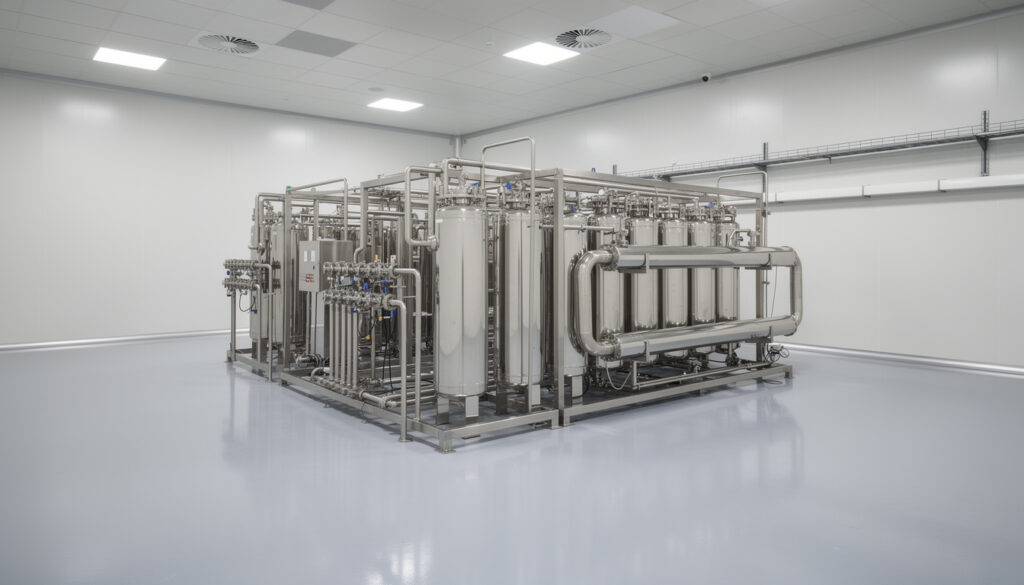
Industrial Deionized Water Systems for Laboratories and Pharma supply the high-purity water that analytical instruments, reagent preparation, and drug manufacturing depend on. An industrial deionized water system removes dissolved mineral ions through synthetic resins, producing critical process water that meets tight analytical and manufacturing tolerances. The sections below cover purification principles, quality specifications, system architectures, pretreatment requirements, sanitary distribution, and maintenance strategies.
Fundamentals of Industrial Deionized Water Systems in Lab and Pharma Applications
Dissolved mineral salts split in water into positive cations and negative anions. In industrial deionized water systems, cation exchange resin swaps those cations for hydrogen ions (H+), and anion exchange resin swaps the anions for hydroxyl ions (OH-). The released H+ and OH- recombine into H2O, so Deionization (DI) water carries almost no dissolved ionic load. Ion exchange resin beads work through chemical affinity and a finite exchange capacity rather than by sieving. A cartridge filter passes dissolved ions untouched, while resin captures them until its active sites fill.
Deionization vs. Reverse Osmosis and Distillation
Distillation removes a broad range of non-volatile impurities through phase change, but it consumes heavy thermal energy. Deionization targets only ionic species and does so with far lower energy demand. Reverse osmosis rejects most ions and organics in a single pass, yet its permeate still shows a few microsiemens of conductivity. Resin polishing brings that figure far lower, which is why modern facilities rarely run deionization alone. Hybrid designs place membranes upstream to cut the ionic load, and resin or EDI finishes the job.
Reading the Numbers: Resistivity, Conductivity, and Grade Selection
Resistivity and conductivity are reciprocals. Ultrapure water at 25 °C reaches the theoretical 18.2 Resistivity (megohm-cm), which corresponds to roughly 0.055 Conductivity (microsiemens/cm). Both readings depend on temperature, so instruments apply compensation. Neither reading detects silica, which is only weakly ionized. Silica removal still matters because silica can distort chromatography baselines and deposit in steam sterilizers.
Laboratory grades follow ASTM D1193, while pharmaceutical Purified Water follows the USP water chapter. Both also limit uncharged contaminants. Total organic carbon (TOC) is capped because organics are invisible to conductivity meters, and microbial counts are held to action levels.
| Grade | Typical electrical target | Typical application |
|---|---|---|
| ASTM Type I | 18.2 megohm-cm at 25 °C | HPLC, trace analysis, cell culture |
| ASTM Type II | Above 1 megohm-cm | General reagent and media preparation |
| ASTM Type III | Above 4 megohm-cm | Glassware rinsing, feed to polishing stages |
| USP Purified Water | Conductivity up to 1.3 µS/cm at 25 °C | Non-parenteral pharmaceutical manufacturing |
Matching grade to task avoids two errors. Over-engineering non-critical rinse water wastes resin and energy, and under-specifying an analytical reagent feed compromises results.
Two-Bed, Mixed-Bed, or EDI: Which Architecture Fits?
A two-bed system keeps cation and anion resins in separate pressure vessels. It suits high-volume duty and costs less to regenerate at scale. Mixed-bed resin intimately blends both types in one vessel, behaving like countless demineralizers in series and delivering superior effluent resistivity. The tradeoff is more complex Resin regeneration, because the two resins must be separated first. Mixed-bed units are usually used as polishers behind two-bed trains, and they run in cycles rather than continuously.
Continuous Demineralization with Electrodeionization (EDI)
Electrodeionization (EDI) combines ion exchange membranes, resin, and direct electrical current. The current continuously regenerates the resin, so hazardous acid and caustic never need handling on site. The arrangement demands discipline, since EDI needs consistent RO permeate upstream. Hardness or chlorine slipping through scales or damages the cell, and an expensive stack is lost.
Common Mistake: Treating Pretreatment as Optional
Untreated raw water fouls resin beads and shortens bed life. Scale precipitating inside a bed causes flow channeling, premature head loss, and sluggish exchange kinetics. A Water softener (hardness removal) unit using sodium-cycle exchange addresses hardness, and precision Antiscalant dosing protects membrane surfaces as an alternative.
Oxidants cause a second kind of damage. Chlorine and chloramines attack the polymer backbone of both resin and polyamide membranes. Chlorine/chloramine removal is handled by Activated carbon filtration or by sodium bisulfite injection. Reverse osmosis (RO) pretreatment then strips out most dissolved solids, leaving DI or EDI stages a minimal ionic load.
Scenario: Water Passes at the Skid but Fails at the Tap
Quality often degrades after production. A Sanitary distribution loop keeps water moving at a turbulent velocity, typically above 1.5 to 2 meters per second, to inhibit biofilm. Storage and loop sizing follow peak instantaneous draw rather than the average output of the production skid. Pumps add heat, so Recirculation and heat control through heat exchangers keeps temperatures from favoring microbial growth.
At loop return points, 0.2 micron final filtration retains particles and bacteria. UV oxidation (TOC reduction) lamps at 185 nm break down organics, while 254 nm radiation provides microbial control.
For additional information, click the attached link: aquaphorpro.com.
Diagnosing Drops, Validating Performance, and Planning Maintenance
Typical excursions include ionic breakthrough, hydraulic channeling, and biological fouling. A fresh or newly regenerated bed may also show a temporary resistivity drop. Carbon dioxide absorbed from air in an unsealed tank forms carbonic acid, which mimics exhaustion. Diagnosis starts with instrument calibration, then temperature-compensated conductivity readings, then inspection of valve seals for cross-contamination.
Validation and Preventive Maintenance
Regulated sites validate through Installation Qualification (IQ), Operational Qualification (OQ), and Performance Qualification (PQ). Routine upkeep includes sanitization cycles, scheduled sensor recalibration, and differential pressure monitoring across filter housings. On-site regeneration is weighed against off-site tank exchange by safety, floor space, effluent handling, and lifecycle cost.
Does deionization remove bacteria and organics?
Not reliably. Resin targets ions, so organics and microorganisms are handled by RO, UV oxidation, and 0.2 micron filtration.
Why is silica monitored separately?
Silica is weakly ionized and barely affects resistivity, yet it can interfere with chromatography and deposit in steam sterilizers.
When does EDI make sense over mixed-bed resin?
EDI fits sites that want continuous output without handling regeneration chemicals and can guarantee consistent RO permeate upstream.
Why does resistivity fall in an open storage tank?
Atmospheric carbon dioxide dissolves into the water and forms weakly ionic carbonic acid, lowering resistivity without any resin exhaustion.
About the Business
AQUAPHOR Professional is a leading manufacturer of advanced commercial and industrial water purification systems. The company provides innovative water treatment solutions for diverse sectors, including industrial, commercial, agricultural, HoReCa, healthcare, and municipal applications.